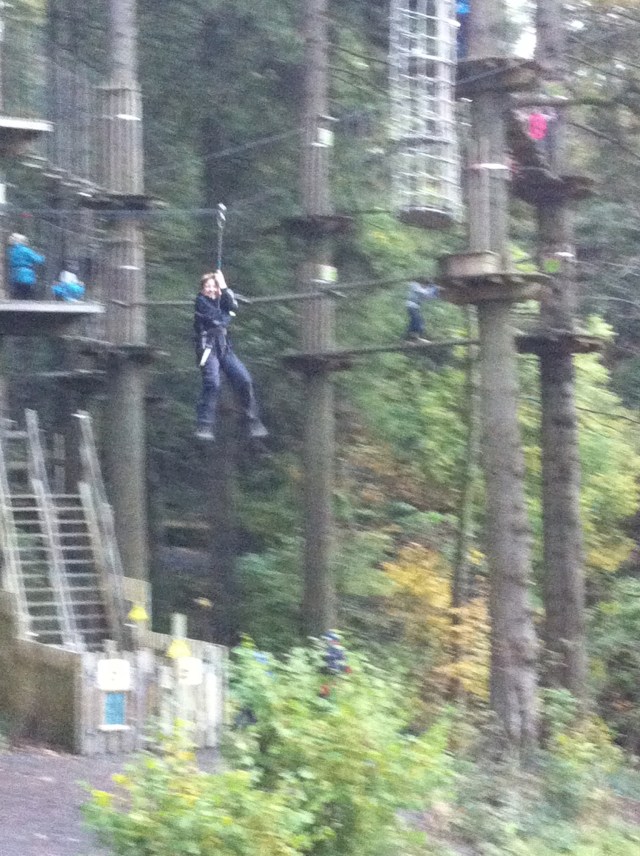
safety cable

img_1724

If you’ve ever stayed in a youth hostel, you’ll know that they can be fun but that the kitchens can be very busy at meal times. We were a group of 12 at the end of a long day and those who were cooking had been looking out for a chance to claim some tables so that we could eat our meal.


We finally managed it and all sat down together. Half-way through the meal, some of the group got up to sort out some pudding and at that point a tired looking dad with some young children asked if he could sit in their seats. I said ‘no’. (Well actually, I wasn’t quite as brutal as that, I suggested that there was another table that was about to be free.)


The second I said it, I regretted it. My motivation, of course, was to protect the space of our group. But why? What was the difference really between us and them?


One of the accounts of the Easter story has got me thinking in the last week (the one in the book of Matthew).   It’s been a couple of days since Jesus died and some of his female friends go to see the tomb where his body has been left. When they get there, the stone covering the doorway is in place and as they stare at that stone, they are probably imagining death inside.


But then there is a dramatic change of perspective. There’s an earthquake that moves the stone aside and they can actually see into the tomb, which is no longer about death, but life. They arrived grieving and hopeless and then are shown a truer reality; the tomb is empty and Jesus is alive. Glory.


At the youth hostel, if I’d been looking at those fellow guests with eyes more accustomed to seeing things as they really are, I would have welcomed them to join us or I would have at least got up and given them my chair. That too would have been glory.


Earlier that day, I’d had the opportunity to do a High Ropes course for the first time and I’d been thinking about the safety cable, which I both needed and didn’t need.


When I say I didn’t need the safety cable, what I mean is that I didn’t slip once. So, technically, I had no need of it. I could have just run round the course in the treetops without any safety feature at all, and been fine.


Except I couldn’t. The safety cable was the only thing that psychologically enabled me to take the first step out onto a wobbly platform. There is no way I could have done without it. The course I saw from the perspective of having a safety cable attached was completely different to the one I would have seen without it.


What would help me see people with truer eyes, the next time someone asks to share my table? I suspect that a grip on my safety cable, reminding myself of God’s love for all of us would have done the trick. Likewise, a life lived with the courage to see that stones will be moved and that tombs needn’t be about death will help me see to take the first steps.


eyebrows

img_5449

I’m a little ashamed to admit this but a few weeks ago when I went to get a haircut in my normal place I saw that they had a special offer on ‘eyebrow shaping’ so I asked about it. I’m not at my most comfortable in a hair salon; the highly-groomed stylists, the mysterious potions and all the make-up make me feel a bit out of place. So even asking the question in the first place took a bit of courage.

What made this require even more bravery is the fact that I’ve always felt a bit self conscious about my eyebrows – feeling they looked a bit more like orange-ish caterpillars than an elegant face-enhancing feature. I also have a memory from a long time ago of a friend saying my eyebrows could do with being improved. (I think I’ve forgiven them now.)

So as I waited in the salon, a glamorous young stylist in her early 20s came over and shone a bright light on my face and said, ‘I can’t do anything to make your eyebrows look better. They are already beautiful.’

I couldn’t believe it.

Surely this isn’t how beauty salons work?

The reason I share this story (and please don’t go scrutinising my eyebrows to see if you agree) is to say that I will remember that stylist and her kind words. I was feeling vulnerable and she completely surprised me with her kindness.  It transforms us when this happens.

I’ve just read a poem called ‘The Lucky Sad’ by Eugene Peterson that is based on some of surprising and paradoxical things Jesus said about being blessed when you’re at the end of your rope, when you feel you’ve lost, when you care enough to be sad – even when people put you down (Matthew chapter 5).

A line in the poem that has stayed with me is:

‘…every hurt is a fossil link in the great chain of becoming’

I can’t really say anything about anyone else’s hurt, but I know in my own experience that there is a peace that comes on the other side of pain and that forgiveness is a gift that God can give us.   Life can be quite an up and down adventure and sometimes we manage the rollercoaster better than other times. What would the journey be like if we let God’s light shine on us and heard God’s words?  You are already beautiful.


21 questions

IMG_5296In the National Trust’s list of 50 things to do before you’re 11 ¾, is the exciting invitation to ‘dam a stream’. I know it’s one of the activities that I most look forward to when we spend time near the beach in Swanage, Dorset. Seriously. It wins over more relaxing activities and even over fish and chips.

I’m not sure what is so compelling about it. There is this little freshwater stream that crosses the sand into the sea and it is so much fun to try to direct it into a channel you have dug yourself or to stop it going in the direction that it wants to go in. But of course, try as we might, the water always wins.  All of our hard work eventually erodes away and if you come back in the morning, it will be almost exactly the way it was the day before.

I may be wrong, but I think it touches something deep inside about wonder, and paying attention. Our world is a mysterious place but we seldom stop to notice.

I was going to write more about this and about my belief that God is at work in our world, but maybe not in the ways that we expect or sometimes even want. But then yesterday our nearly-10 year old son produced as list of 21 questions he’d written and that we wants us to talk about. I have to confess that I don’t even understand all of the questions, let alone know all of the answers, but I love that he’s asking them.

Like dam-making and cloud-watching, these questions are another way into wonder. What would you say?

  1. What is life?
  2. What are we doing on this earth?
  3. What would God like us to do on this earth?
  4. If God never existed what would we like to do?
  5. What is our final destination?
  6. What is in our soul?
  7. What helps us live?
  8. What does the Pope mean by ‘Wake up’?
  9. Are we asleep? Unaware of the greatness around us?
  10. What would help us see the greatness around us?
  11. What does ‘slain’ truly mean?
  12. Do we praise God properly? VGA (various great ascensions)
  13. Where do we walk?
  14. What do we have to do to become angels?
  15. Do we have any answers?
  16. Why would Christ come again?
  17. What does Jesus mean by saying ‘all you that are carrying heavy bones come, and you will receive rest?
  18. Is Jesus’ blood everlasting?
  19. What evil comes our way?
  20. Why do people say ‘nothing bad can happen to me because I’m united with Christ’? That’s not true.
  21. Where is home?

Pupating Pete

IMG_5253

I don’t have anything against caterpillars but I’m not sure I’d ever thought that they were lovable before last week. We’d met up with some friends in Peterborough for the day and when we saw Peter and decided that he was uni-pillar (because of his elegant blue horn) and noticed the adorable little waggling dance he was doing, I was a bit smitten, too.

Children are brilliant and helping us to see things in new ways.

Another thing that opened up our eyes was using a few cards from our Sneaky Cards pack. https://sneakycards.com It’s a hard concept to explain but it is a kind of interactive scavenger hunt game (pre Pokemon Go!) that challenges you to be a secret agent of joy. One of our cards suggested that we buy someone a coffee (and then give that person the card so that they are invited to do the same for someone else). As we walked around, looking for the right person to receive a free coffee, we were more alert to the people around us. The woman we chose was touched and it was fantastic to meet her. We met several other people using the cards that day.

It was a fun day and it was interesting to notice how the joy increased even more as we shifted our attention beyond ourselves.

When we got home, we searched the internet to find out what kind of caterpillar Pete was (he’d gone home with our friends). It turns out he was a Lime Hawk Moth and that the wiggling he’d been doing was a sign that he was ready to build a cocoon. Ooops. We probably should have left him where he was. I’m guessing he didn’t enjoy his trip to McDonalds, nor the leaves and water we offered him.

Though we thought Pete was amazing, we didn’t understand what was going on. (But we know for next time!)

Life brings us good days (like our day in Peterborough) as well as challenging ones and sometimes it is tricky to understand what is really going on. Since becoming a British citizen a couple of weeks ago, and what feels like increasingly scary world, I am even more conscious that I am also a citizen of God’s kingdom, where a deeper reality lies. When life is tough, it is sometimes possible to understand things differently, like a dark cocoon, or a push off of a cliff edge can be the beginning of learning to fly.


wanting

IMG_5086

Sluuuuurrrrrp! Munch, munch, munch. Crunch, crunch, crunch. Sluuuurrrrrp! Big grin. This was after his older brother had repeatedly asked our youngest to eat his cereal with his mouth closed. I have to say that this morning wasn’t the most harmonious breakfast we have ever enjoyed together.

I’m in complete agreement, by the way, about the whole closed-mouth-chewing thing but it was hard not to laugh at the sheer joy to be had in tormenting a brother. It’s quite difficult being a parent sometimes, especially when you can clearly remember how much fun it was to tease your siblings yourself.  I hope my brother and sister have forgiven me for the fun that I often took at their expense. (I might need to double-check on that.)

We have some things that we usually do on our ‘prayer stair’ most evenings. We often read a bit of the Bible and then talk about it or pray with it, or even draw pictures in response to it. It’s nice but it’s usually pretty tame.

Recently our 9 near old took charge and devised a prayer time involving beanbags and a tall cardboard box. What we had to do, he said, was to attempt to knock over the box with the 3 beanbags while saying what we were sorry for. That part was relatively easy. The next stage, though, was to attempt to throw a beanbag inside of the top of the narrow box while saying things that we wanted to forgive. That was harder in more ways than one.

What I realised, when I searched my memory for 3 things to say, was that the things that I wanted to forgive were from years ago. They weren’t big things but they clearly still had a hook in me. I was surprised myself at what I said.

It made me realise what a good question it was. What do you want to forgive? There wasn’t an ‘ought’ about it. It wasn’t the result of a logical thought process. It was a free and open question, just like the best questions from children are.

What does it take to want to forgive? I think it might be something about where you want to go. Do I really want that grudge hanging around in my subconscious? Do I want to carry my own lack of freedom? Do I want to experience the life that God calls me to? Maybe ‘wanting’ isn’t exactly the same as doing it, but I guess it could be the first step.

mercy

IMG_1403

When we go on walks with our kids (ok, maybe I should more truthfully say ‘when we force our kids to go on walks’) we end up having lots of chats that I don’t think we would otherwise have. Walking is brilliant for having really meandering, wondering kinds of conversations.


A conversation on our last walk was about whether we were ‘glass half full’ or ‘glass half empty’ people. I can’t remember exactly how we scored each other, but I know that when we realised that our 13 year old had left his hoodie behind in the motorway services, we never expected to get it back.


He was devastated. For those of you who see him frequently, it was the hoodie that he always wears. A part of him. We weren’t even sure which of the motorway services we had stopped in on our 300 mile drive, but we gave Moto services in Tamworth a ring. Not only did they find it but they posted it to us – free of charge. Isn’t it incredible when people go the extra mile, and especially when you least expect it?


But then, there was the angel postman. We were only about half-way through one of our day’s walk and very tired and hot, slumped with our backpacks on the side of a field along a narrow lane. All of a sudden a post van pulled up and a cheerful man got out and asked how we were doing and where we were going. And then he asked if we had enough water.


We didn’t. We were running low and weren’t sure where we could get more. ‘You can have some of mine,’ he said, and promptly came over and almost completely re-filled my water bottle with his. And then he drove off.


I don’t know about you, but when I am tired and low and least-expecting it, the kindness of a stranger can have an enormous impact. The boost was much, much more than an increase in our water supply.


I recently saw something new in some familiar words from in the Bible. ‘My thoughts are not your thoughts’, God says, ‘neither are your ways, my ways’. That always seemed kind of obvious to me – God’s ways and thoughts of course must be different to human ones. (Isaiah 55)


But then I noticed the sentences that come before, which are all about God’s mercy. It’s God’s mercy that is not like our ways or our thinking. God’s mercy towards the people that we might be tempted to judge or avoid is way beyond our comprehension.


I wonder how often I think of God in a glass-half-empty kind of way instead of seeing the overflowing goodness; not just to me- but to everyone. This chant has been reminding me of the gift:

Let all who are thirsty come

Let all who wish receive

The water of life freely

Amen, come Lord Jesus

in

IMG_4674

If there was ever a bunch of pilgrimage groupies, that has been us. We’ve been following Philip’s progress across Spain every night, moving an arrow along the map in our book, we’ve been reading in the morning about what kind of day it looked like he was going to have and have even checked the weather.

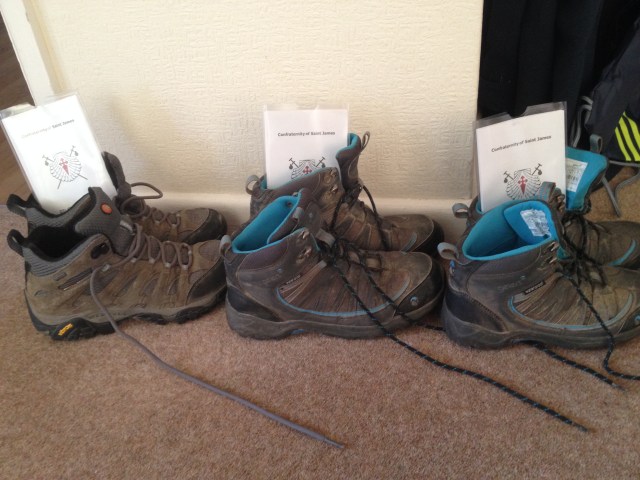
I think we’ve participated in the Camino as much as we possibly could without actually walking the whole ‘Camino Frances’. He’s sent photos and we’ve been in touch. We left out our hiking boots to remind us that we were still pilgrims, in a way, too.

Through some amazingly grace-filled circumstances (and generous parents) I was able to go out to meet Philip in Santiago de Compostela at the end of his 500 mile walk. It felt like a very precious gift.

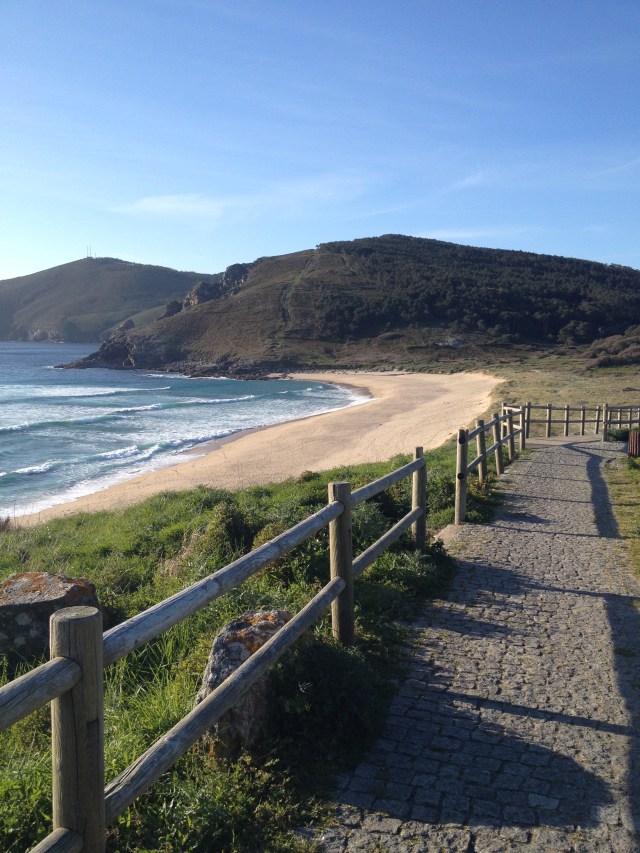
We went to Mass in the Cathedral packed with pilgrims and breathed the incense of the huge Botafumeiro and we looked for scallop shells on the beaches of Fisterra. We watched the sun set from the lighthouse at the westernmost tip of Spain. We drank wine and ate tapas with pilgrims from different countries. It was wonderful.

I probably could have been mistaken for a person who had just walked the Camino, wearing hiking boots and carrying a backpack and doing lots of things that pilgrims were doing.  But actually, I wasn’t really a pilgrim in the sense that others were. I hadn’t joined in their struggle to get there, or been anywhere near as vulnerable.

At home, my job is about co-ordinating an internship scheme that encourages youth participation in the church. I’ve been thinking, the last few weeks, that I don’t really like the word ‘participation’; that for me, the word has connotations of following the rules, fitting in the with norm, joining in the ways things are usually done. I’ve been trying to think of a better word.

The more I’ve thought about it, however, my dislike of the word has changed. I’ve remembered that Jesus used the analogy of being part of an organic vine to describe the interconnectedness of God and people, and that, more than once, he said ‘come and see’ to people who were searching.   Come and see what things look like from where I am standing, come and experience this life for yourself.

Several years later, when Paul was trying to explain this way of Jesus, he often used language that was about participation. I have to confess that some of it is still quite mysterious to me. I imagine Paul, sitting hippie-like and cross-legged on a beach, when he came up with phrases like being ‘in Christ’, ‘through the life of Christ’ and ‘alive to God through Christ’. Being a Christian for him was about participating in the life of Jesus, jumping with joy into that river of faith and seeing where it might take you.

Perhaps this is a teeny tiny bit of the rebel in me, but I still don’t feel drawn to participate in institutions or classes or even causes.  I do, however, feel drawn to really participate with others in the life of Jesus, worked out in the way of the cross, through faithfulness, vulnerability and love. To be a pilgrim and not to just act like one.


IMG_4673IMG_4676IMG_4647IMG_4646IMG_4605IMG_4625


maximum joy

IMG_4499

On our second day of walking, our 9 year old said, ‘I think this is ultimate joy’. He went on to explain what he meant. ‘Ultimate joy’ was when something was really challenging, but you wanted to do it, and then you managed it. He compared it to the way his teacher from last year, Mr Daniel, inspired his class and made him really want to do well.


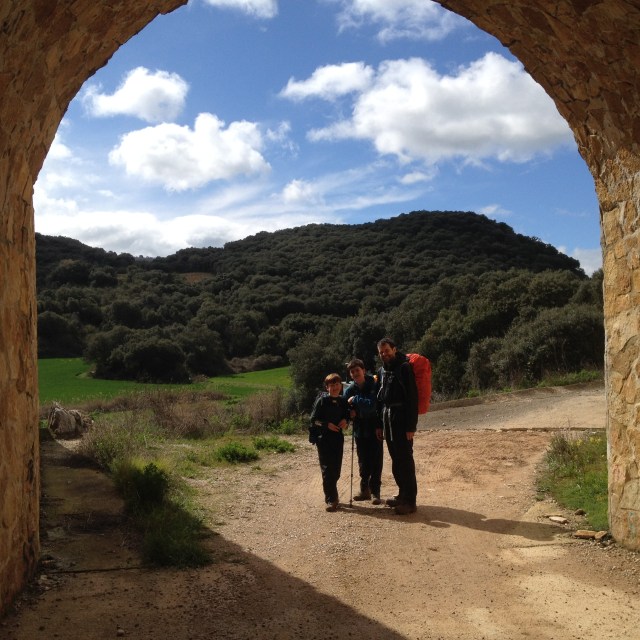
The boys and I were doing a mini-pilgrimage, alongside my husband who is doing a much longer one. Our bit of the Camino Frances to Santiago de Compestela was 1/16 of what most of our fellow walkers were planning to do, and we were walking alongside them near the start of their 500 mile journey. So my perception of what walking the Camino is like is limited, but I have to say, there is nothing I would rather do now than go back and walk the rest. It really is as hard and as wonderful as everyone who has walked it says that it is.


Our first day was clouded (metaphorically and literally) by the early morning realization that our youngest had lost his raincoat the day before and that heavy rain was predicted. We knew we had to get an early start in order to make it to our hostel in the evening and we couldn’t wait for the shops in Pamplona to open. We had to just set off, in the semi-darkness, hoping that we would find a way to make it possible.


Our backpacks felt particularly heavy as we trudged up the hill out of town. Every time we stopped for a rest, an elderly Austrian woman, who never seemed to stop her slow steady pace, passed us by with a smile. Soon the rain started and we swapped our raincoats so that only my husband was without one, getting very cold and wet. Both of us said later that, at this point, it wasn’t clear that we were going to be able to make it.


It was a couple of miles after this that we met our first angel. In a tiny roadside shop selling coffee (hooray!) and chocolate and plastic ponchos a lovely, caring woman in her early 30s, chatted and cheered us up, letting us take up her entire shop space, huddled inside, dripping all over her floor. She fitted my husband with a poncho, and then, realizing that his arms were still uncovered, spent a considerable amount of care cutting and tying plastic bags on his arms so that they would be protected from the rain. I don’t feel like I can express what this meant to us. Meeting our level of despair and need, her caring made it possible for us to go on. Our hearts were warmed by her kindness.


It rained for most of the day, but we never doubted that we could do it after that. Our legs were like jelly by the time we reached Puente de la Reina and hung up some of our wet things to dry in our warm and dry hostel. That night, enjoying a warm ‘pilgrim’s menu’ in a local restaurant, we laughed about the day and enjoyed being together. We slept very well in our bunk beds that night.


Knowing a bit more what to expect the next day, and that the route of the Camino was very clearly marked and that our fellow walkers, from many parts of the world, were friendly and encouraging, we set off with a bit more confidence. Already, people we had met earlier, we greeted like friends. I shared some of our dried mango with a woman from Ecuador who was doing the whole Camino on her own. Our younger son befriended a young Korean woman and our eldest tried out a few French phrases with a French couple and greeted some Hungarians in their native language.


This day was hard too, from a walking point of view, but the smiles of others helped us all along and the landscape was beautiful and changing, at some points our way taking us along Medieval cobbled streets, then through fields and among trees. Even when it took us alongside a motorway, we passed a fence where pilgrims seemed to have woven twigs and grass between the wires to form crosses, making what might not have been particularly inspiring, mysterious and thought-provoking.


By the time we reached the town of Estella, we were all comparing our personal ‘battery levels’. Most of us were at 2% or less. Then we discovered that the convent we had arranged to stay in was at the top of a steep hill, overlooking the town. It was one of those parenting moments when you barely have the strength to get yourself to where you need to be, let alone the energy to cajole the kids along, too, but somehow we managed it.


We were met at the door of the Monasterio San Benito http://www.monasteriosanbenitoestella.com by a tiny and elderly Sister Esperanza, who showed us to our rooms and took away our boots and waterproof trousers to wash and dry, showing straightaway her community’s commitment to welcome all guests as if they were receiving Christ. We joined the 12 nuns in their evening prayer, which I could partly follow and included Psalm 122 which begins ‘ I rejoiced when I heard them say, let us go to the house of the Lord…’ and which somehow felt perfect for that moment.


In that chapel and at a few points walking during the day, I had felt deep, unexplainable joy. Maximum joy. It was tinged with sadness, knowing that the boys and I were going to leave the next day and that my husband, Philip, would be continuing on his own without us, but it was joy, nonetheless. Sister Esperanza got up early the next morning so that we could have breakfast before we caught our bus back to Pamplona, and, seeing our tears as she served us, said that the way of the cross involves both suffering and gladness. Giving things up for the sake of Jesus is the way to become more like him. And the way to maximum joy.


camino ready

IMG_4291

Outraged, our younger son ran upstairs and threw himself on his bed. Our crime had been to catch a large spider under a glass with the intention of putting it outside. ‘You’ve frightened it, ‘ he shouted through his tears. ‘You could have just opened the door and beckoned it outside!’

I don’t know if I was more surprised at his use of the word ‘beckon’ or that he seemed to believe that it was possible to be a spider whisperer. If only it was that easy to get rid of things we want to get rid of. If only we could beckon things away.

In this pre-Easter season, it is common to think about the yuckiness in our lives that we want to get rid of. (Sorry, spider-lovers, I’m not meaning to imply that they are alarming to everyone.) What is the best way to do that?   Attack?  Sheer doggedness and determination? I’m sure those things have their place in breaking bad habits, but what about unhealthy thought patterns and less than loving responses?  How can we get those to scuttle away?

On a weekend retreat for teenagers and parents recently, we spent time with a bit of the Bible; Romans 12, and as I looked back through my journal, I found these bits of paraphrased wisdom that seem to provide some of the answer:


Be cheerfully expectant

Remember your identity: beloved

Don’t try to be a great somebody

Be inventive in hospitality

Get the best of evil by doing good

Love from the centre of who you are


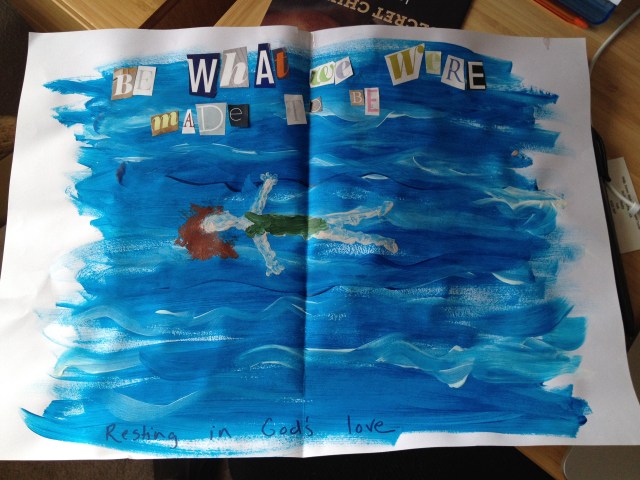
When we had a bit of time to mess around with some poster paint, I tried to capture a picture I had in my head of floating on God’s love (it’s not meant to look like a drowned body) and the trust involved in letting that love carry us. Is it too passive a picture?

As my husband gets ready for his 5-week pilgrimage on the Camino to Santiago de Compestela and the rest of us prepare for our few days of walking with him, our older son jokes that we are ‘Cami-not-ready’. But how could we ever be, really? A journey of faith just requires one step after another, trusting the one who beckons us towards an open door with love.

IMG_4279


Hild

IMG_4172

In those hazy days before either of our two boys were born, the name ‘Hilda’ was definitely on my shortlist of ‘girl names’.   I’m not sure that anyone I mentioned this to at the time thought it would be a good idea  But after spending a few days this week with Hild (in my imagination, at least) I’m still a fan.

We’ve been spending our days walking some of St Hilda’s Way (our route took us from Runswick Bay to Lealholm to Whitby and back again to Runswick Bay) and in the evenings I’ve been reading a historical novel about Hilda called ‘The Abbess of Whitby’ by Jill Dalladay.

Staying at the youth hostel in Whitby, amazingly close to the ruins of a more recent abbey and very near to where Hild herself once built a Christian community made it all come alive even more. Our final day walking from that site and up the coast was gloriously sunny and the sea was so blue that we kept talking about it’s blueness.

The previous two days, however, were either so freezingly windy or wet and muddy that our conversation was mainly about how cold or how miserable we were (apart from when we were singing ‘I Can’t Feel My Face When I’m With You’) or trying to find where we were on the map.

Despite how our bodies were feeling, I think there were still moments when we could enjoy where we were. There is something about walking that forces you to live in the present – whether watching an owl circling, looking for prey, appreciating the stones and roots in our path that made the mud less slippery, or feeling deep gratitude for a pub radiator or open fire.

Maybe it made it easier to imagine living in 7th Century Britain, too. Of course no one knows what Hild was really like, but she must have been wise and open-minded and and welcoming and brave, in days when humans were much less protected from mud and wind.

Our kids have never responded to the suggestion of an extended walk with unbridled enthusiasm. They think that it will be boring. They know that it will be hard. So do I, if I’m honest. However, I also know that doing challenging things together makes us more open, helps us know love in new ways and builds up our confidence for the journey ahead.

And, actually, no one said ‘bored’ until we got home.